Surfacing Credit Potential
to Drive Cross-Sell
Improve UserFlow of the «Cash Loan» Page







Understanding the Task
Problem
Underutilization of credit potential leads
to lost revenue — lower average ticket on cash loans and cross-sell to other credit products within the available potential does not work
Task
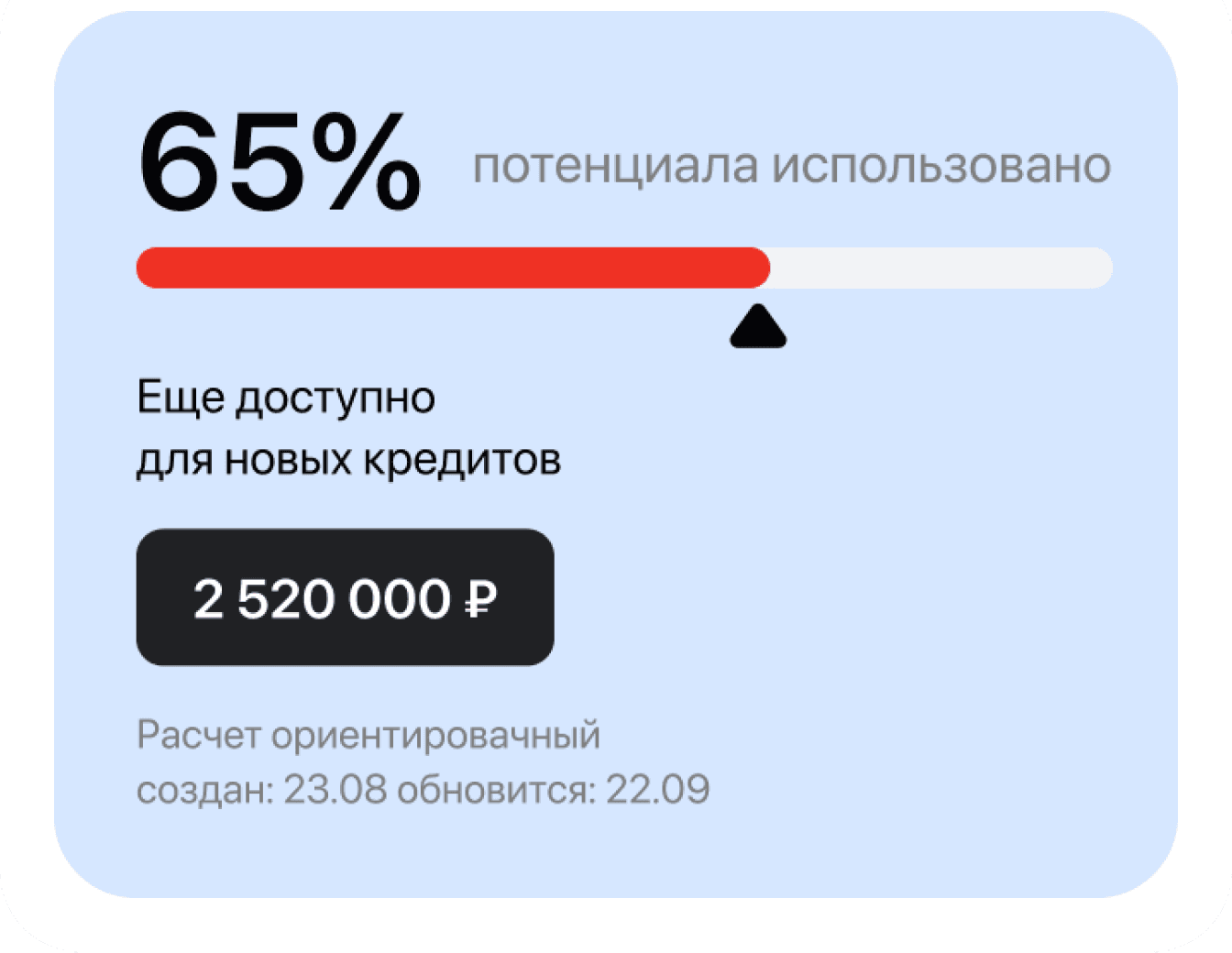
Add credit potential information
to the “Cash Loan” page of Alfa-Bank
Business Hypothesis
Adding a credit potential block will increase the average loan ticket, conversion rate, and stimulate additional applications
Constraints
Mobile version, compliance with alphabank.ru website
User Survey
This survey addresses the key preparatory goal: to confirm actual pain points and needs of real users when choosing a loan, and to identify how important and clear the “Credit Potential” service is to them View Survey Results!
6/9 respondents
Understand the term “Credit Potential” and correctly associate it with the maximum amount from the bank, but a third of the audience confuses it with reliability or history — the need to briefly explain the term remains
7/9 respondents
Consider the idea “interesting”, negative
or neutral — minimum. Interest in the service is high
4/9 respondents
Want to see not only the maximum amount,
but also alternative products
4/9 respondents
Main barriers to taking more money —
fear of not being able to handle payments
5/9 respondents
Fear submitting an application due to the risk
of worsening their credit history
6/9 respondents
Show rational financial behavior — calculate their actual payments, only 1/9 focuses on the “maximum”

Desk Research
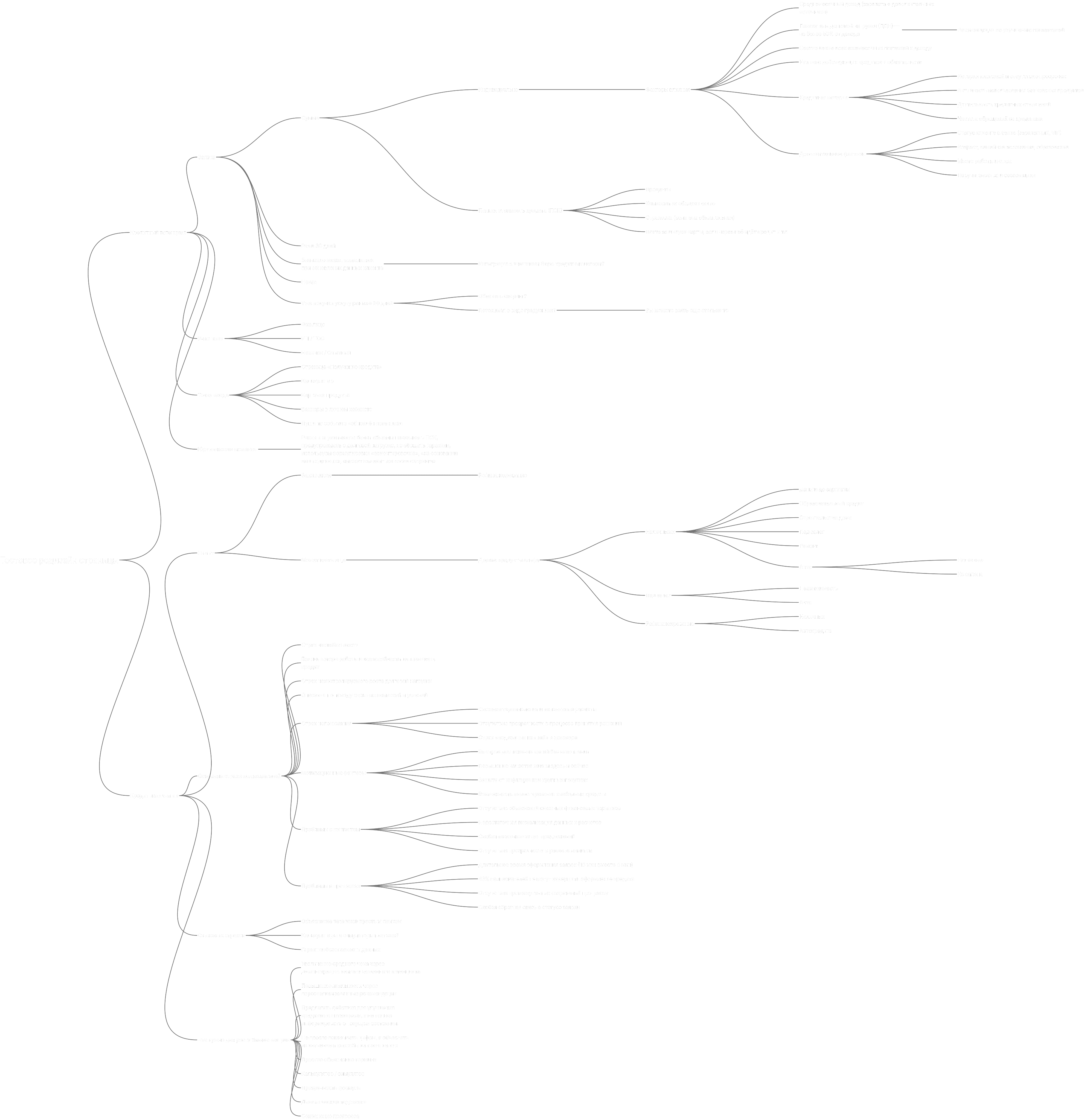
This research allowed me to immerse myself in the lending environment; it will help to effectively address user scenarios through understanding psychological characteristics, Alfa’s business goals, and development constraints. I studied: “Definition and Calculation of Credit Potential”, “Scoring, Rating, and Approval Factors”, “Market Practices
and Credit Potential Services”, “UX and Banking Interface Problems” Link to Mindmap!
View Materials “Credit Potential”
data was taken from studied articles in open access

Formed Hypotheses (top 4)
View in Figma
H2 (729)
If a link “How much can the bank approve” is added to the calculator,
then more people will reach the amount selection and submit an application,
because we remove fears: misunderstanding, rejection, the unknown — increasing the number of applications
07
IMPACT
Will increase trust and boost
applications, but won\’t produce exponential growth
08
CONFIDENCE
Directly requested in research,
reaction is positive
09
EFFORT
Banner is implemented quickly,
UI effort is minimal
H5 (576)
If auto-saving of the application is enabled and the user is returned to the last step
upon re-entry, the share of completed applications will grow, because we remove the frustration of re-filling and losing time
08
IMPACT
Reducing churn rate,
saving user\’s time
08
CONFIDENCE
UX standard, already practiced
by competitors
09
EFFORT
Many implementation examples,
pattern is clear
H6 (540)
If the client hits the limit but is willing to provide collateral or refinance,
then highlighting alternatives will redirect some to another product and increase conversion
06
IMPACT
Reduces legal risks and removes questions, but does not affect the ticket
09
CONFIDENCE
Without this it\’s impossible
in production due to compliance
10
EFFORT
Minimum resources,
tooltip or short label
H1 (480)
If a banner explaining “Credit Potential” is added to the “Getting a Loan” page, users will more frequently increase their application amount and submit loan applications with greater confidence
07
IMPACT
Clients learn about “Credit Potential”,
it can also serve as an entry point
into the feature
08
CONFIDENCE
Directly requested in research,
reaction is positive
09
EFFORT
Banner is implemented quickly,
UI effort is minimal
Expected Results
+15%
Increase
in average ticket
+6%
Conversion growth
into application
-30%
Reduction of rejections
of amount
Success Metrics
Primary: conversion, average ticket, completed applications
Secondary: time on page, repeat visits
A/B testing plan, composing design experiment with PA

Competitive Analysis

Conclusion: Avoid service isolation, integrate
into the main flow, while there are no alternatives on the market.
Alfa can create the best solution on the market
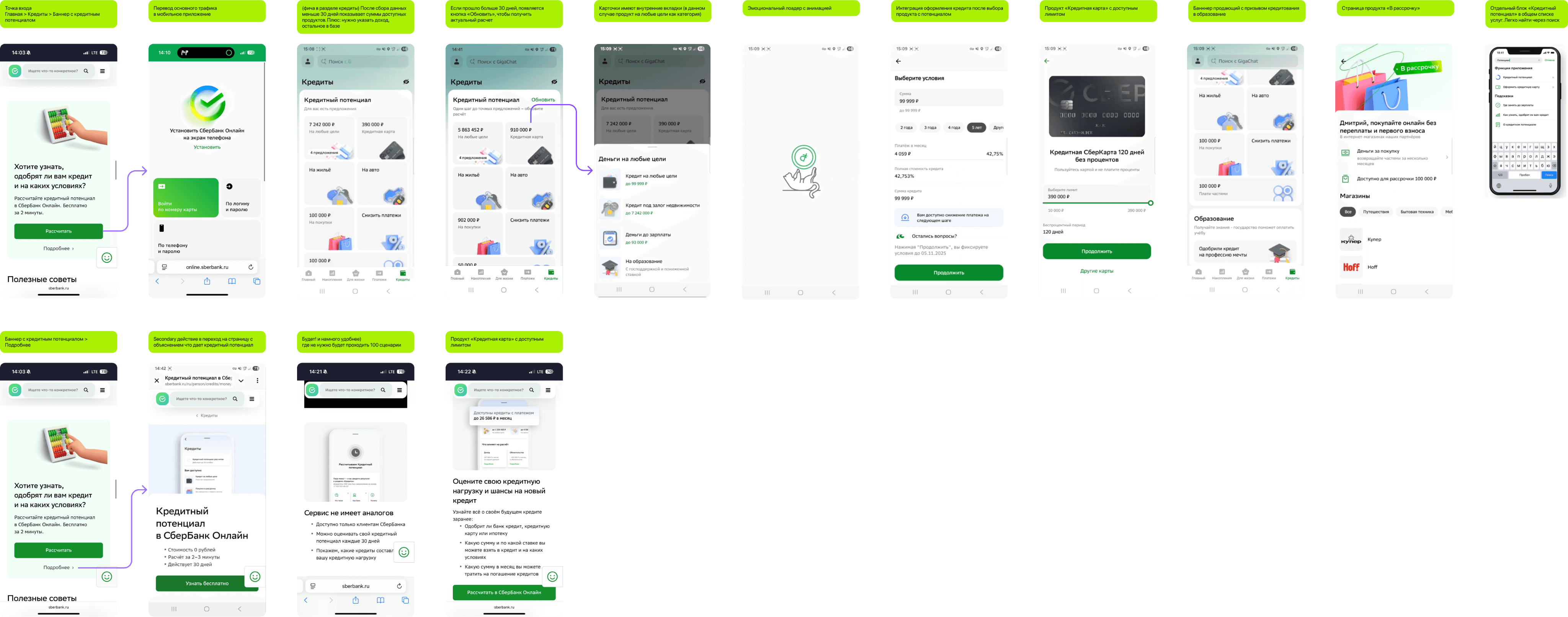

Conclusion: Capabilities info is visible through credit rating visualization, calculation is integrated into the basic scenario, no separate potential service — but the functionality is the same

Conclusion: simple and informative calculator, the scenario is close to credit potential. Availability and limit statuses can be added when entering parameters

User-Flow
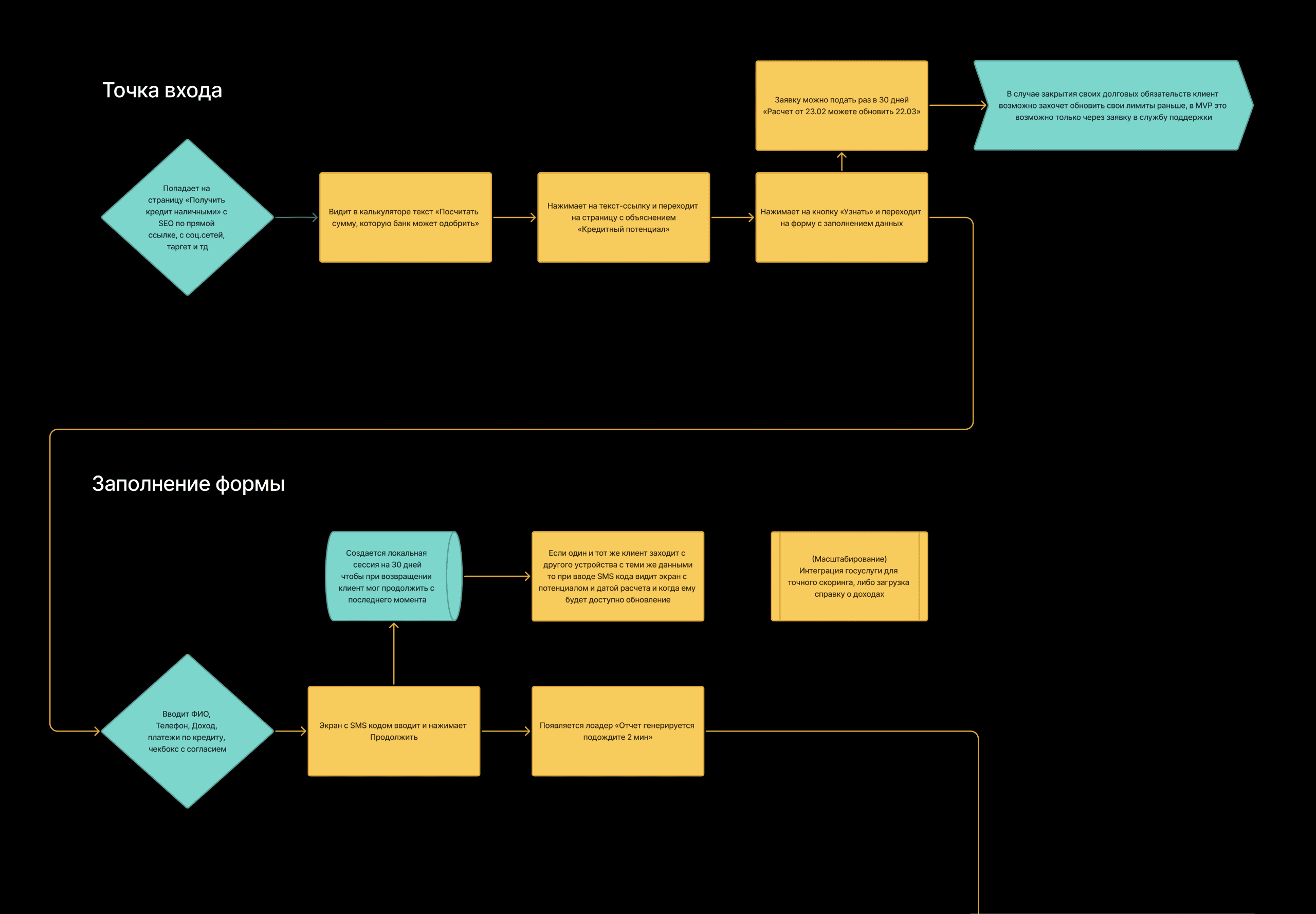
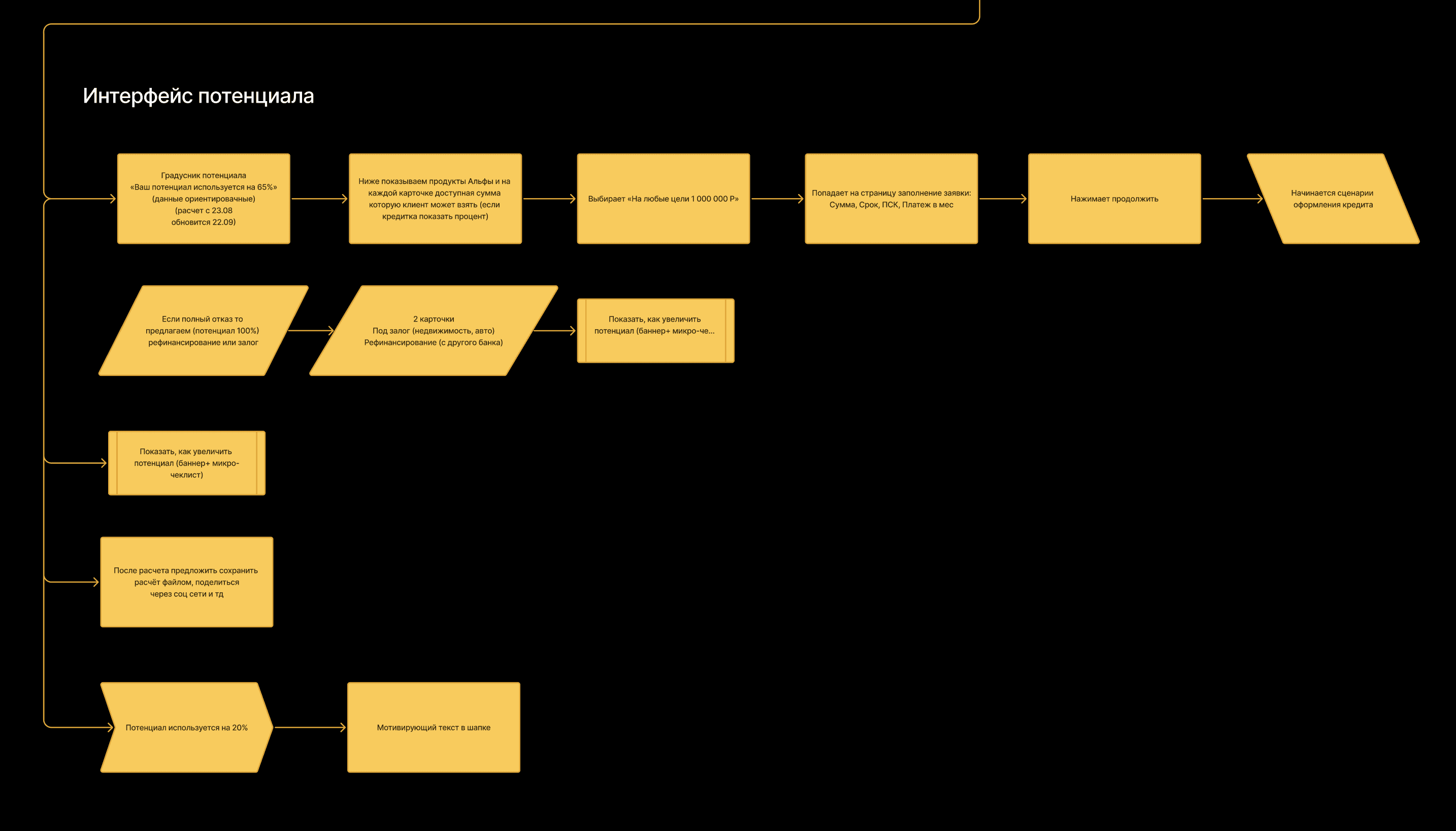
Cash Loan → Calculator button “Find out for free how much the bank can approve” / Banner “Want to know your credit maximum?” → Fill in a short form → Wait 2 min → Your potential is 65% / Rejection — we recommend collateral or refinancing, also tips on limits
View in Figma
Technical Feasibility
API integration with Credit Bureau
Minimal data for MVP
State preservation without authorization
Auto-save of the application to return later
Scenarios
View all in Figma

Hypothesis #2
If a link “How much can the bank approve for you” is added to the calculator, then more people will reach the amount selection
and submit an application, because we remove fears: misunderstanding, rejection, the unknown.
This way we increase the number of applications

Hypothesis #1
If a banner with an explanation of “Credit Potential” is added to the “Getting a Loan” page, users will more frequently increase their application amount and submit loan applications with greater confidence

The visual style of the new page matches the alfabank.ru website as per the specification
Removing fear: does not affect
your credit rating

Calculation form is filled out
Minimal amount of data for MVP
suitable to quickly test hypotheses via A/B
Calculation form is filled out
Minimal amount of data for MVP
suitable to quickly test hypotheses via A/B

Hypothesis #8
If a “potential thermometer” is added
with a mark “you\’re using 62% of available” and a hint “up to X without increasing credit load”, the average applied amount will grow, because the person sees a safe margin and understands where their limit is
Government Services Integration at Scale
Next Steps
MVP: launch of the main potential calculation form and the result screen
(4–6 weeks)
v1.1: adding personalization, pulling in recommendations and alternative products (2–4 weeks)
Preparation and conduct of additional usability testing for qualitative feedback
(7 days)
v2.0: deep integration with other bank products and expansion of scenarios (credit cards, refinancing, etc.)
Conclusions
What Didn\’t Work
– Scaling the research to a larger sample
(dropout of participants without loan experience reduced coverage)
– When identifying user barriers through the survey
did not restrict respondents and got invalid data, but afterwards I segmented and recruited the target audience for this task
– Failed to test reactions to multiple
microcopy variants and different wording of the term
“credit potential” — a zone for A/B testing remains
– Limited time did not allow for deeper
development of customization for different client segments
What I Learned
– In fast-paced conditions, selecting key insights from limited data and making product conclusions,
it reminded me at some point of UXBoost (a fast hypothesis challenge) — the task turned out interesting to dive into
– Setting up audience filtering at the survey stage — sample purity sharply improved quality
Managed to build a solution on real data and user insights, though quantitative data needs more, but the goal was, I believe, to demonstrate the tool
Identified the presumed main pain points — fear for credit rating, desire to see the maximum, interest in alternatives
Created a design integrated into the basic flow, not an isolated service — this will allow testing the idea seamlessly, cheaply and quickly
v2.0: deep integration with other bank products and expansion of scenarios (credit cards, refinancing, etc.)
View in Figma
