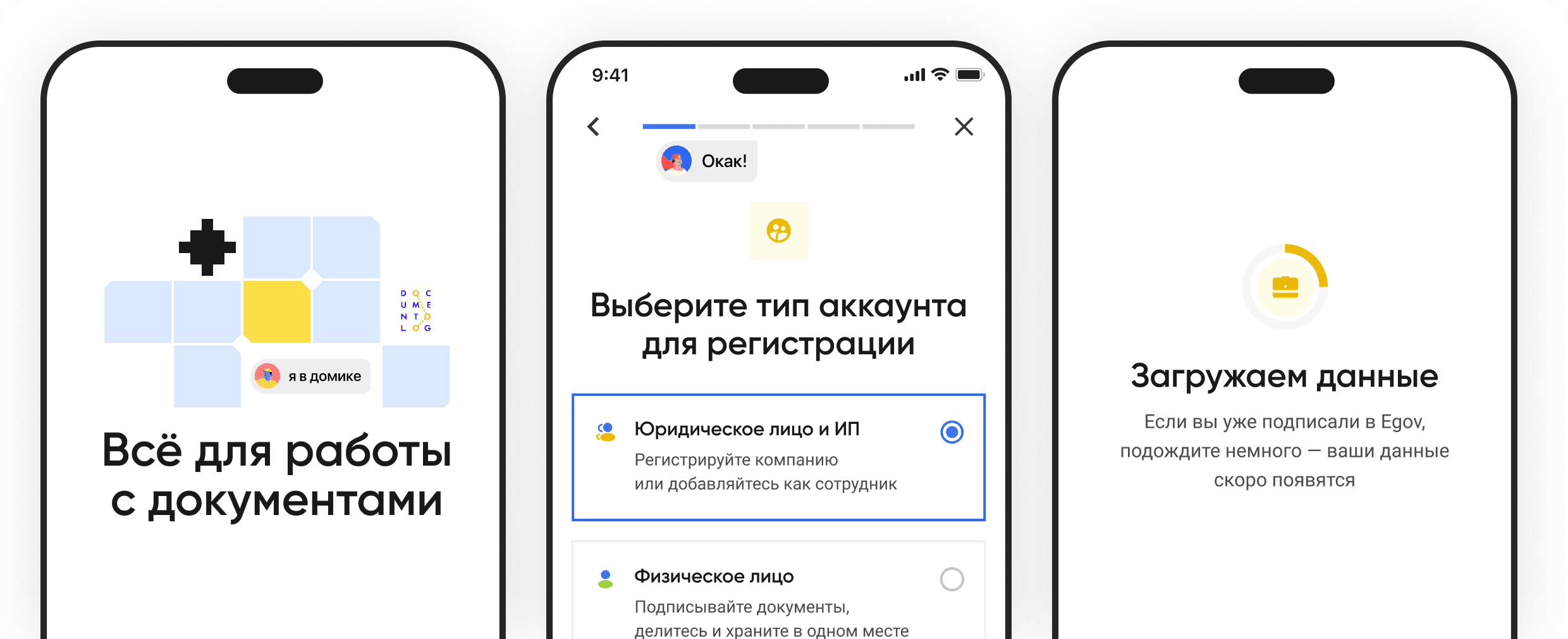
Understanding the Task
Problem
Only 8% of legal entities complete registration (baseline), and 91%
of people drop off at steps 2 and 3, preventing the product from demonstrating first value after registration
Task
Increase the conversion rate for completing legal entity registration and reduce drop-off at step 2 (23% drop-off) and step 3
(68% drop-off)
Solution (focus hypothesis)
If we redesign the registration flow for legal entities by removing or deferring complex steps (e.g., moving company verification after the first product action), it will increase registration completion and allow the service value to be shown faster
Success Criteria
Churn Reduction
at steps 2 and 3 (leading)
-15%
Churn Rate
Conversion to completion
of company registration (lagging)
+10%
CR registration
Results
-5%
Churn Rate at Step 2
(Leading)
-14%
Churn Rate at Step 3
(Leading)
+7%
Conversion to completion
of company registration (lagging)
What Worked
Simplified registration flow: deferring company verification reduced cognitive load and removed the barrier at entry
Quick sense of value: users saw the interface and potential value before entering data
Clear communication of limits helped avoid negative reactions
What Didn’t Work
Insufficient trust triggers
Despite simplification, some users retained distrust of the service without an identity verification step — this was reported in surveys
Scenarios


Work Process
Immersion
Understanding the Task
Kick-offs
Gathering Artifacts
Business Strategy
Metrics
Discovery
Defining User Needs
Market Analysis
Goals and Success Criteria
Research Planning
Hypotheses
In-depth Interviews
Flow Analysis
Prioritization
Hypothesis Validation
Prototypes
User-Flow
Lo-Fi Wireframe
Tests
Usability Testing
Completion Rate
Pathway
Completion Time
A/B
A/B Comparison
Development
Preparing Mockups
Corner Cases
Design Review
Retro
Key Insights
We conducted interviews and a mini-survey among 10 users with IE who started registration as a legal entity but did not complete it
#1 Survey
3/10 respondents “I didn’t understand why I had to enter all the data before seeing how the system works”
4/10 respondents “It seemed like it would take a long time. There was no sense that I was close to the finish”
#1 Insight
Users note that registration feels “too long” and “bureaucratic”, especially before getting any value from the product
#2 Insight
Only 8% of legal entities complete registration fully. The main drop-off (91%) occurs at steps 2 and 3, where company verification and data confirmation are required
Conclusion
A complex and lengthy registration flow blocks the product’s core value before first use. This is especially critical for the legal entity segment, where conversion to activation is 4–5x lower than for individuals. Simplifying onboarding is key to improving
activation and retention
Hypotheses
Focus Hypothesis
If we redesign the registration for legal entities by removing or deferring complex steps (e.g., moving sole trader / LLC details after the first product action), it will increase registration completion and allow the service value to be shown faster
#1 Hypothesis
If we merge steps 2 and 3 of registration into one screen with hints and auto-fill by BIN, we will reduce drop-off and increase registration completion
#2 Hypothesis
If we move the entry of legal data after the first action (e.g., document creation), it will reduce friction and allow the system to engage the user before collecting required data
#3 Hypothesis
If we offer a quick start without entering all legal entity data (e.g., “start with a test profile”), users will be able to test the product faster and make a transition decision
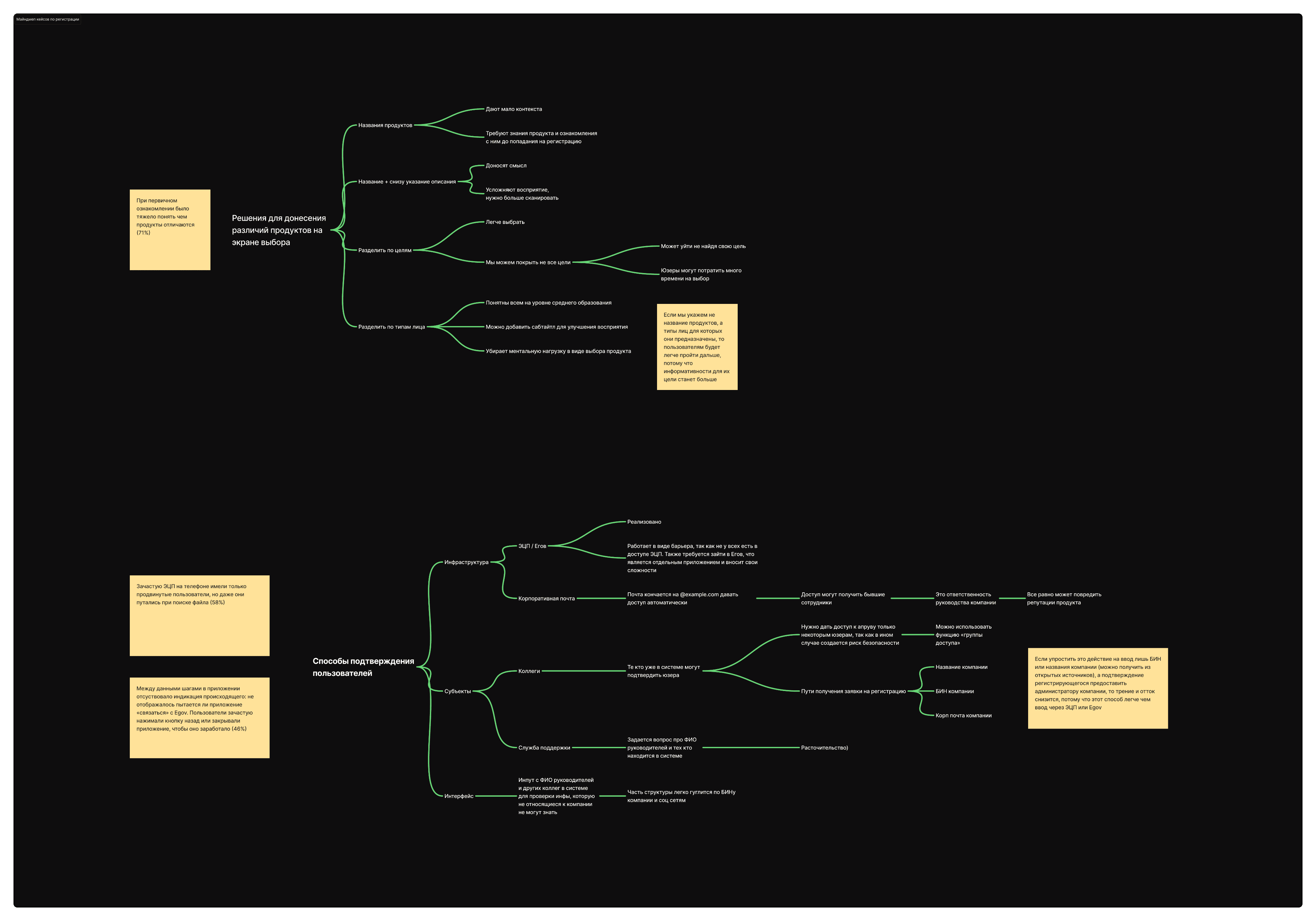
Mind-Map
Visualization of the registration path for legal entities
User-Flow
Visualization of the company registration path

Results
-5%
Churn Rate at Step 2
(Leading)
-14%
Churn Rate at Step 3
(Leading)
+7%
Conversion to completion
of company registration (lagging)
What Worked
Simplified registration flow: deferring company verification reduced cognitive load and removed the barrier at entry
Quick sense of value: users saw the interface and potential value before entering data
Clear communication of limits helped avoid negative reactions
What Didn’t Work
Insufficient trust triggers
Despite simplification, some users retained distrust of the service without an identity verification step —
this was reported in surveys